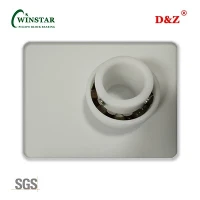

How Does The Stiffness Affect The Performance Of A Flange Ball Bearing?
Oct 16, 2026
Stiffness is a crucial factor that significantly influences the performance of flange ball bearings. As a flange ball bearing supplier, I've witnessed firsthand how stiffness can either enhance or detract from the overall functionality of these bearings in various applications. In this blog, we'll delve into the relationship between stiffness and the performance of flange ball bearings, exploring how it affects key aspects such as load - carrying capacity, precision, and durability.
Understanding Stiffness in Flange Ball Bearings
Stiffness in a flange ball bearing refers to its ability to resist deformation under an applied load. A stiffer bearing will experience less elastic deformation when a force is exerted on it. This characteristic is determined by several factors, including the material properties of the bearing components, the design of the bearing, and the pre - load applied to it.
The material of the bearing plays a fundamental role in its stiffness. For example, high - quality steel with a high modulus of elasticity will result in a stiffer bearing compared to a lower - grade material. The internal design of the bearing, such as the number and size of the balls, also impacts stiffness. A bearing with more balls or larger balls generally has higher stiffness as it can distribute the load more evenly.
Pre - loading is another important factor. By applying a pre - load to the bearing, we can increase its stiffness. This is often done to eliminate internal clearance and improve the bearing's ability to handle radial and axial loads. However, excessive pre - loading can lead to increased friction and heat generation, which may reduce the bearing's lifespan.
Impact on Load - Carrying Capacity
One of the most significant ways stiffness affects the performance of a flange ball bearing is in its load - carrying capacity. A stiffer bearing can withstand higher loads without excessive deformation. When a load is applied to a bearing, the balls and raceways experience stress. A stiffer bearing distributes this stress more effectively, preventing localized over - stressing that could lead to premature failure.
In applications where heavy loads are common, such as industrial machinery or automotive transmissions, a high - stiffness flange ball bearing is essential. For instance, in a large - scale manufacturing plant, conveyor systems rely on flange ball bearings to support heavy loads of materials. A stiffer bearing in these conveyors can handle the weight without deforming, ensuring smooth and reliable operation.
The Conveyor Hanger Flange Unit Bearing is a prime example of a bearing designed to handle high loads. Its robust design and high - stiffness construction make it suitable for heavy - duty conveyor applications. The stiffness of this bearing allows it to maintain its shape and performance even under significant loads, reducing the risk of breakdowns and downtime.
Influence on Precision
Precision is another critical aspect of flange ball bearing performance, and stiffness plays a vital role in achieving it. In applications where high precision is required, such as in machine tools or robotics, a stiffer bearing can provide more accurate positioning and movement.
When a bearing is subjected to a load, any deformation can cause misalignment, which can affect the accuracy of the machinery. A stiffer bearing minimizes this deformation, ensuring that the components it supports move precisely as intended. For example, in a CNC machine, the flange ball bearings need to provide precise movement to ensure the accuracy of the machining process. A high - stiffness bearing will maintain its shape and position, allowing for more precise cutting and shaping of materials.
The Pillow Block Bearing Units are known for their high precision. Their stiffness helps in maintaining the alignment of the rotating shaft, which is crucial for the accurate operation of the equipment. The ability to resist deformation under load ensures that the machinery operates with minimal error, improving the quality of the end - product.


Effect on Durability
Stiffness also has a direct impact on the durability of flange ball bearings. A stiffer bearing is less likely to experience excessive wear and tear over time. When a bearing deforms under load, it can cause uneven stress distribution on the balls and raceways, leading to premature wear.
In addition, a stiffer bearing can better withstand shock and vibration. In applications where there are sudden impacts or vibrations, such as in construction equipment or mining machinery, a high - stiffness bearing can absorb these forces without significant damage. This reduces the need for frequent bearing replacements, saving both time and money.
The Ductile Iron Housing And Units are designed with high stiffness in mind. The ductile iron housing provides a rigid structure that protects the bearing from external forces and helps maintain its internal integrity. This results in a longer - lasting bearing that can withstand the rigors of demanding applications.
Optimizing Stiffness for Different Applications
As a flange ball bearing supplier, we understand that different applications require different levels of stiffness. For light - duty applications, such as in small household appliances, a lower - stiffness bearing may be sufficient. These bearings are designed to provide smooth rotation with minimal friction and cost.
On the other hand, heavy - duty applications demand high - stiffness bearings. In industries like aerospace, where safety and reliability are of utmost importance, the bearings need to be extremely stiff to handle the high loads and stresses.
We work closely with our customers to understand their specific requirements and recommend the most suitable flange ball bearings. By considering factors such as the type of load, operating speed, and environmental conditions, we can select the bearings with the optimal stiffness for each application.
Conclusion
In conclusion, stiffness is a key factor that affects the performance of flange ball bearings in multiple ways. It impacts the load - carrying capacity, precision, and durability of the bearings, making it essential to choose the right stiffness for each application.
As a flange ball bearing supplier, we are committed to providing high - quality bearings that meet the diverse needs of our customers. Whether you are looking for a bearing for a light - duty application or a heavy - duty industrial machine, we have the expertise and products to meet your requirements.
If you are interested in purchasing flange ball bearings or have any questions about our products, please feel free to contact us for a detailed discussion. Our team of experts is ready to assist you in finding the perfect bearing solution for your application.
FAQ
Q: What Factors Affect the Stiffness of Flange Ball Bearings?
A: The stiffness of flange ball bearings is mainly influenced by material properties, internal bearing design, and preload. Using high-quality steel with a high modulus of elasticity, optimizing the number and size of the balls, and applying an appropriate preload can help improve bearing stiffness. However, excessive preload may increase friction and heat generation, potentially shortening the bearing's service life. Therefore, preload should be carefully adjusted according to the specific application requirements.
Q: How Does Stiffness Affect the Load-Carrying Capacity and Precision of Flange Ball Bearings?
A: Higher stiffness helps reduce elastic deformation under applied loads, maintain stable contact between the balls and raceways, and improve positioning accuracy and operational stability. In applications such as conveyor systems, CNC machine tools, and robotics, appropriate bearing stiffness helps improve load support, minimize component misalignment, and ensure precise equipment operation. However, the actual load-carrying capacity also depends on factors such as material strength, internal design, lubrication conditions, and the operating environment.