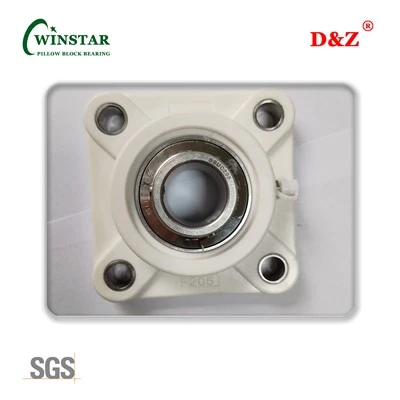
How many types Thermoplastic Bearing units are there?
1. Square Flanged Thermoplastic Units (fpl200ssn)
Square flanged thermoplastic housings and units are important components in many applications, which require durable and lightweight housings to protect various machinery and equipment. They are specifically designed to provide an efficient and cost-effective bearing unit that can withstand harsh conditions and extreme temperatures.They are lightweight and suitable for a range of applications, such as food manufacture, medical equipment, and chemical processing.
2. Thermoplastic Pillow Block Bearings
Thermoplastic housings with stainless steel bearings are mainly used in the pharmaceutical and agricultural industries. These bearing units have smooth surfaces which can prevent dust, moisture, or bacterial retention. The lubricating grease used is odorless, and tasteless which is harmless to food. Our stainless steel bearings have good resistance to chemical reagents such as acids, alkalis, organic solvents, and high temperatures
3. Oval Flanged Thermoplastic Housing And Units
Thermoplastic double bolt oval flange housing with stainless steel inserts: bearing unit with fully sealed stainless steel insert bearings which installed in plastic housing that are pre-installed with anti extrusion stainless steel inserts in bolt holes, and also includes a grease nipple for re-lubrication. The stainless steel bearing insert has 2 grub screws to tighten onto the shaft after installation. The insert bearings can be removed from the housing for future replacement if you need.
4. Thermoplastic Take Up Bearings
Thermoplastic Take Up flange bearings are stainless steel mounted bearings that are fixed in a plasitic block and they are generally used to align conveyor belt tracks to maintain belt tension. If you have questions about our take up flange unit bearings, our team would be happy to discuss your specific needs. Contact us now!
Material of Thermoplastic Bearing
Stainless steel 304
AISI 304 stainless steel, widely used as corrosion- and heat-resistant steel and also as nonmagnetic steel, is most suitable in corrosive environments where AISI 440C stainless steel can not be used.AISI304 Stainless Steel bearings are particularly useful in industries such as food and beverage processing, medical equipment, and marine applications.
Stainless steel 420
420 stainless steel is a martensitic stainless steel that is recognized for its unique combination of strength, corrosion resistance, and impressive wear resistance.Stainless Steel Ball Bearings are ideal for many industries, including marine and food and washdown areas.
Plastics
Plastic housings provide superior resistance to corrosion as compared to standard series cast iron units.
Specification of Thermoplastic Bearing
Specific product parameters, please click it
Application of Thermoplastic Bearing
Food processing
Plastic housings and stainless steel bearings are widely used in food processing facilities because they can resist the corrosion of common chemicals and other substances in these facilities.
Automotive
In the automotive industry, plastic housings and bearing units are used for various applications, such as engine components, transmissions,suspensions and so on.
Agriculture
The agricultural industry is an ideal environment for plastic housing and stainless steel bearings, as they can work in harsh outdoor environments and resist a range of chemicals and substances present on site.
Medical
Plastic housing and bearing units are used in the pharmaceutical and medical industries due to their biocompatibility
What you should know when use Thermoplastic Bearing Units?
1. Regularly clean the bearings
One of the simplest and most important maintenance ways for thermoplastic housing and bearing units is regular cleaning. Over time, dust, dirt, or other pollutants may accumulate on the bearings, which can lead to performance degradation and premature wear. To prevent this from happening, we can use a soft brush or cloth to wipe away any debris, and then rinse the bearings with water or a mild cleaning agent. Before we reassemble the bearings, it is essential to thoroughly dry the bearings.
2. Properly lubricate the bearings
Another key maintenance mothed for thermoplastic housing and bearing units is the proper lubrication. Proper Lubrication can reduce friction between bearing components, thereby minimizing wear. But, it is important to use the appropriate type and amount of lubricant, too little or the wrong lubricant can actually cause damage to the bearings. Consult the manufacturer's recommendations to obtain suitable lubricants and use them according to instructions.
3. Timely inspect and replace the worn bearings
Over time,even with appropriate maintenance, thermoplastic housing and bearing units may still wear . We should regularly inspect the bearings for signs of wear, such as deformation, cracking, or excessive play. If any of these issues are found, please replace the bearings as soon as possible to prevent further damage. Please make sure to order replacement bearings from a trusted supplier to ensure the highest quality and performance.
4. Take Precautions When we install the Bearings
When we install or reassemble thermoplastic housing and bearing units,please take appropriate preventive measures to avoid damaging the bearings.To ensure that all surfaces in contact with the bearings are clean and free of debris. And we should use appropriate tools and techniques to secure the bearings in the right place and prevent them from becoming loose or damaged during we use them.
Components of Thermoplastic Bearing Units
Plasic housing
The plastic housing is usually made of high-strength polymers such as polyamide or polyester. This kind of material is resistant to chemicals, ultraviolet radiation, and corrosion, so it is an ideal choice to choose plasitic housing in harsh environments. This housing is designed to provide safe and stable installation for stainbless steel bearing inserts.
Stainless steel bearing
Compared with ordinary bearings (chrome steel bearings), stainless steel bearings not only have obvious advantages in material, but also have much stricter control in technology and accuracy. Stainless steel bearings work stably, have low noise, are corrosion-resistant, and are widely used during the working process.
What is the process of Thermoplastic Bearing Units ?
Material selection
It is the first step in ensuring that a bearing will perform correctly and meet the operational requirements.
Cutting the steel pipe
The first step in producing ball bearings is cutting the steel pipe. Steel is an essential material for making ball bearings because it is strong and durable. The steel pipe is cut into small pieces known as blanks. These blanks will eventually become the spheres that are the most important part of a ball bearing.
Machining
It includes the processes of lathe and grinding. Lathes are used in the initial processing of the bearings by removing material from the object while grinding machines are used in the finishing process. We have the High precision machines to achieve tight tolerances and measurements which are required in producing quality bearings.
Heat treatment
After machining, the ring is heat-treated to improve its hardness, strength, and wear resistance. This is usually done through a process of quenching and tempering, which involves heating the ring to a high temperature and then rapidly cooling it.
Cleaning the rings
It is very important to clean the rings before assembling, as 1.Prolong the lifespan of the bearing.2.Prevent corrosion.3. Maintain the efficiency of the bearing 4. Reduce the risk of machine failure
Assemble bearings
When the rings are ready, we assemble with steel balls and a cage to form the complete bearing unit. The balls are between the two rings, to create a smooth and friction-free rotation.
Lubrication
Finally, the bearing is lubricated with grease or oil to reduce friction and wear.
Testing
After finished bearings, we will do various quality control tests to ensure bearings’ performance and durability. These tests can include measuring vibration, noise, rotation speed, load capacity and so on.
Marking items and brand
When the bearings are tested, we will mark items and brand on the rings, both customers' brand or our CTS brand are ok. We do the brands according to our customers' need.
Assemble bearing and housings
Assembling bearings and housings is a crucial step in the installation process. A poorly executed installation can lead to issues such as premature failure, increased friction, and noise. We have a team of professional workers who are experts in assembling these components to ensure that the whole bearings units are assembled with utmost accuracy and efficiency.
Making package
This process is extremely important as it ensures the safety and integrity of the mounted bearings during transportation and storage.
Delivery
we have a powerful system in place to ensure smooth and timely delivery of our products. We work with trusted shipping partners to ensure that our bearings reach our clients in the shortest possible time. We also offer various packaging options to ensure the safety of our products during transit.
Compared with traditional Thermoplastic Bearing Units, our this product have some advantages
High-quality materials
To ensure the durability and longevity of our thermoplastic housing and bearing units, we choose high-quality matericals for the goods, then they can withstand wear and bear,perform at its best even under pressure conditions.
Providing better protection against contamination
With our advanced sealing function, our bearing units help prevent the entry of harmful pollutants which may cause damage and shorten the service life of traditional bearing units.
More efficient and reliable
With our excellent design and advanced technology, our thermoplastic bearing units require less maintenance and provide smoother operation over long periods of use.
More cost-effective
Our bearings have a significant cost advantage as it can reduce maintenance, extend service life, and overall energy efficiency.
Q: What are plastic bearings used for?
A: Plastic ball bearings are often used in the automotive industry and aerospace engineering. Wherever lightweight is important, our light plastic ball bearings are ideal.
Q: What is thermoplastic housing?
A: Thermoplastic housing is lightweight, durable, and resistant to impact, chemicals, and UV radiation,it is a popular choice for products that require high strength and resistance to environmental factors.They are commonly used by the Food & Beverage, Chemical and Pharmaceutical industries with stainless steel bearings often available in colours such as Black, White, Green and Blue.
Q: Are plastic bearings good?
A: If you need corrosion-resistant, non-magnetic, or non-conductive bearings, plastic bearings are the ideal choice. However, compared to chrome steel bearings, these bearings have limitations in load handling, speed, and accuracy due to their softer materials.
Q: Do plastic bearings need lubrication?
A: Whenever possible, lubricating plastic bearings is always a good idea because it can reduce friction and wear, lower power consumption, and extend the lifespan of parts. For example, research has shown that the service life of lubricated plastic bearings is five times longer than that of non lubricated bearings.
Q: What is the difference between a pillow block and a flange bearing?
A: Pillow block bearings can support shafts running horizontally, vertically or at an angle – as long as the block is mounted on a surface running the same way. Flange block bearings are essentially the right-angled equivalent. Flange block bearings support shafts which are perpendicular to the mounting surface.
Q: Why is stainless steel used for bearings
A: Stainless steel bearings are used where there is a risk of corrosion. Chromium steel bearings are prone to rusting, so it is recommended to use stainless steel bearings in humid or chemical environments, such as in the food/beverage industry.
Q: What material are pillow block bearings made of?
A: Cast iron: widely used for its strength and cost-effectiveness,which is suitable for general applications. Stainless steel: With excellent corrosion resistance, it is an ideal application for food processing or exposure to humid environments
Q: What grade stainless steel for bearings?
A: 440 grade stainless steel is the most commonly used for corrosion-resistant ball bearing. In 440 grade stainless steel, chromium reacts with oxygen in the air and form a chromium oxide layer, also known as a passivation film, on the surface of the steel.
Q: Are plastic bearings good?
A: If you need corrosion-resistant, non-magnetic, or non-conductive bearings, plastic bearings are the ideal choice. However, compared to chrome steel bearings, these bearings have limitations in load handling, speed, and accuracy due to their softer materials.
Q: What are plastic bearings?
A: Plastic bearings are five times lighter than steel bearings,then it can reduce the weight and energy required for rolling. For low load and low-speed applications in harsh environments, they eliminate the problem of rusted steel bearings and their inevitable repeated replacement, saving your time and money.
How To Cooperate With Us?
Contact us
The first step is to get in touch with us. You can reach us through our website, email or phone. We will respond to your inquiry as soon as possible, and our customer service team will be ready to assist you.
Share your requirements
Once we hear from you, we will discuss your requirements in detail (The items with quantity what you need, material…). We want to understand your needs and expectations to provide you with the best possible solution. We will guide you through the process and help you select the right bearings for your application.
Customization
We offer customization options to our customers. Our experienced engineers will work with you to design bearings with housings that meet your specific needs and requirements. We will provide you with a sample of the customized bearing for your approval before we manufacture it.
Manufacturing
After confirmed what you need for the mounted bearings, then we arrange the producing. We have the latest technology and equipment to manufacture bearings that meet the international standards. We can produce bearings in large quantities and deliver them on time, even for urgent requests.
Quality control
Quality control is a top priority for us. We have strict quality control measures throughout our manufacturing process to ensure that our customers receive high-quality bearings every time. We perform rigorous testing and inspection of each bearing to ensure that it meets our quality standards before we ship it to our customers.
After-sales support
We are here to help you with any issues or questions you may have regarding our bearings. We offer maintenance and repair services to ensure that your bearings continue to perform at their best.