


What Is The Creep Resistance Of Thermoplastic Bearings?
Jun 24, 2026
What is the Creep Resistance of Thermoplastic Bearings?
As a supplier of this bearings, understanding the various properties of our products is crucial. One of these important properties is creep resistance. Creep is a phenomenon that occurs in materials when they are subjected to a constant load over an extended period of time. This leads to a slow and progressive deformation of the material, which can have significant implications for the performance and longevity of components, especially in applications where precision and stability are required.
Understanding Creep in Thermoplastics
Thermoplastics are a type of polymer that can be melted and re - molded multiple times. Unlike thermosetting plastics, which undergo a chemical change during curing and become rigid, thermoplastics have a more flexible molecular structure. When a thermoplastic bearing is under load, the polymer chains within the material can start to slide and rearrange themselves over time. This movement causes the bearing to deform gradually, even if the load is well below the material's yield strength.
Several factors influence the creep behavior of thermoplastics. Temperature is a significant factor; as the temperature rises, the mobility of the polymer chains increases, making the material more prone to creep. For example, in an industrial oven where thermoplastic bearings are used, the elevated temperature can accelerate the creep process. The magnitude of the applied load also plays a role. Higher loads will generally result in more rapid creep, and the duration of the load is equally important. A short - term high - load situation may cause less creep compared to a long - term low - load application.
Importance of Creep Resistance in Thermoplastic Bearings
In many applications, creep resistance is a critical property for this bearings. Consider a conveyor system in a manufacturing plant. The bearings in the conveyor rollers are constantly under the weight of the products being transported. If the bearings have poor creep resistance, they will gradually deform over time. This deformation can lead to misalignment of the conveyor belts, increased friction, and ultimately, motor overload and equipment failure.
In the aerospace industry, where weight reduction is a top priority, thermoplastic bearings are increasingly being used. However, these bearings must maintain their dimensional stability under various operating conditions, including different temperatures and loads. Creep can cause changes in the bearing's internal clearance, which can affect the smooth operation of the aircraft's components. For instance, in the landing gear or engine systems, any unexpected deformation due to creep could have serious safety implications.
In the medical field,that bearings are used in various devices such as surgical robots and diagnostic equipment. These applications require high precision and reliability. Creep in the bearings could lead to inaccurate positioning of surgical instruments or incorrect readings in diagnostic machines. Therefore, high - creep - resistant thermoplastic bearings are essential to ensure the proper functioning of these life - saving devices.

Our Company's Approach to Enhancing Creep Resistance
As a thermoplastic bearing supplier, we have dedicated considerable resources to improving the creep resistance of our products. One of the ways we achieve this is through the selection of high - quality raw materials. We carefully choose polymers with high molecular weight and a well - balanced molecular structure. These polymers tend to have stronger intermolecular forces, which resist the movement of the polymer chains under load, thereby reducing creep.
We also add various fillers and reinforcements to our thermoplastics. For example, glass fibers can be incorporated into the polymer matrix. These fibers act as a reinforcing phase, providing a rigid structure within the material. The glass fibers help to distribute the applied load more evenly and prevent the polymer chains from sliding past each other. This significantly enhances the creep resistance of the bearing.
In addition to material selection and reinforcement, our manufacturing process is also optimized to improve creep resistance. We carefully control the molding parameters, such as temperature, pressure, and cooling rate. By ensuring uniform cooling and proper densification of the material, we can minimize internal stresses and voids in the bearing. These defects can act as weak points in the material and accelerate the creep process. A well - manufactured bearing with a consistent and dense structure will have better resistance to creep.
Our Product Range with High Creep Resistance
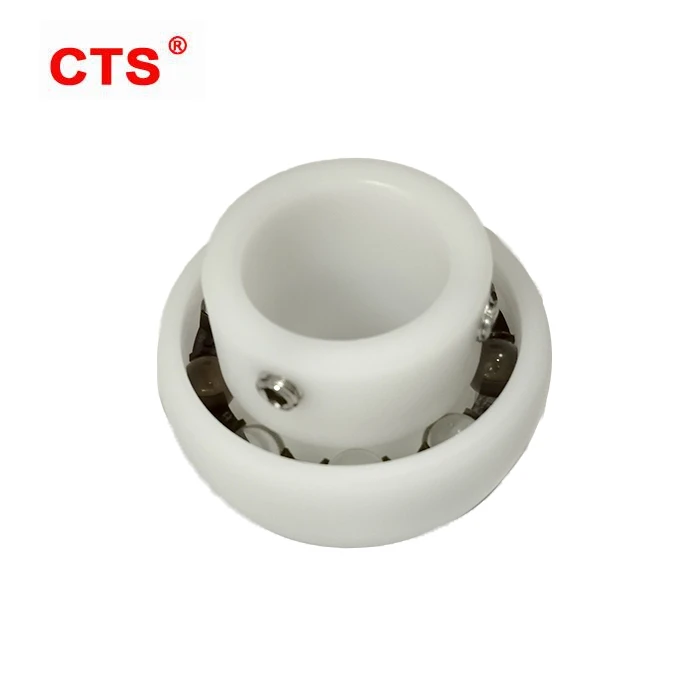
We offer a diverse range of thermoplastic bearings with excellent creep - resistant properties. Our Custom Plastic Bearings can be tailored to the specific requirements of our customers. Whether it is a unique shape, size, or load - bearing capacity, we can design and manufacture bearings that meet these needs while maintaining high creep resistance.
Our Thermoplastic Pillow Block Bearings are designed for applications where a smooth and stable operation is needed. These bearings are widely used in conveyor systems, industrial machinery, and agricultural equipment. Thanks to their high creep resistance, they can withstand long - term loading without significant deformation, ensuring reliable performance over an extended period.
The Square Flanged Thermoplastic Housings and Units in our product lineup also feature high - quality thermoplastics with excellent creep resistance. These housings provide a secure and stable mounting for the bearings, and their resistance to creep ensures that the alignment and performance of the overall system are maintained.
The Future of Creep - Resistant Thermoplastic Bearings
As industries continue to demand more efficient and reliable components, the advancement of creep - resistant thermoplastic bearings will become even more important. We are constantly researching and developing new materials and manufacturing techniques to further improve the creep resistance of our products. With the development of nanocomposites and advanced polymer blends, we expect to see even greater improvements in the performance of this bearings in the future.
Contact Us for Your Thermoplastic Bearing Needs
If you are in the market for high - quality thermoplastic bearings with excellent creep resistance, we invite you to contact us. Our team of experts is ready to assist you in selecting the right bearings for your specific application. We can provide detailed technical information, samples, and competitive quotes. Whether you are in the automotive, aerospace, medical, or any other industry, we have the solutions to meet your requirements. Let's work together to ensure the smooth and reliable operation of your equipment.
References
"Engineering Plastics: Properties and Applications" by Don V. Rosato
"Polymers in Engineering" by Brian Ellis
"Thermoplastic Materials and Their Composites" by M. N. Rahaman


