
What Are The Standard Sizes Of Mounted Bearings?
May 14, 2026
When it comes to mechanical systems, mounted bearings play a pivotal role in ensuring smooth operation. As a leading supplier of mounted bearings, I'm often asked about the standard sizes of these essential components. In this blog post, I'll delve into the details of the standard sizes of mounted bearings, providing you with the information you need to make informed decisions for your applications.
Understanding Mounted Bearings
Before we dive into the standard sizes, let's briefly understand what mounted bearings are. Mounted bearings are assemblies that consist of a bearing mounted in a housing. The housing provides support and protection for the bearing, and it also allows for easy installation and alignment. Mounted bearings are used in a wide range of applications, including conveyors, agricultural equipment, food processing machinery, and industrial automation systems.

Types of Mounted Bearings and Their Standard Sizes
There are several types of mounted bearings, each with its own set of standard sizes. Here are some of the most common types and their corresponding size specifications:
Pillow Block Bearings
Pillow block bearings are one of the most widely used types of mounted bearings. They consist of a bearing housed in a block with a flat base, which is typically bolted to a surface. The standard sizes of pillow block bearings are based on the bore diameter of the bearing, which can range from as small as 1/4 inch to as large as 10 inches or more. The overall dimensions of the pillow block housing, including the length, width, and height, also vary depending on the bore diameter and the specific design of the bearing.
Flange Mount Bearings
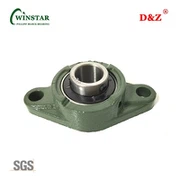
Flange mount bearings are another popular type of mounted bearing. They feature a flange that is used to mount the bearing to a flat surface, such as a machine frame or a panel. There are different types of flange mount bearings, including square flange, round flange, and oval flange bearings.
The Square Flange Bearing Housing is a common type of flange mount bearing. Standard sizes for square flange bearings are specified by the bore diameter of the bearing and the size of the flange. The bore diameter can range from a few millimeters to several inches, while the flange size is typically measured in inches or millimeters. For example, a common square flange bearing size might have a bore diameter of 1 inch and a flange size of 3 inches by 3 inches.
Take-Up Bearings
Take-up bearings are designed to adjust the tension in a belt or chain drive system. They typically have a slotted base that allows for easy adjustment of the bearing position. The standard sizes of take-up bearings are determined by the bore diameter of the bearing and the maximum adjustment range of the take-up mechanism. Bore diameters can vary widely, depending on the application requirements, and the adjustment range can be specified in inches or millimeters.
Conveyor Hanger Flange Unit Bearing
Conveyor hanger flange unit bearings are specifically designed for use in conveyor systems. They are used to support the conveyor belt and ensure smooth movement. These bearings typically have a unique design that allows for easy installation and adjustment. The standard sizes of conveyor hanger flange unit bearings are based on the bore diameter, the outer diameter of the bearing housing, and the overall height of the unit. The bore diameter can range from small sizes suitable for light-duty conveyors to larger sizes for heavy-duty applications.
Zinc Alloy Bearing Units KFL000
Zinc alloy bearing units are known for their corrosion resistance and durability. They are commonly used in applications where the bearing is exposed to harsh environments, such as food processing and outdoor machinery. The standard sizes of zinc alloy bearing units are based on the internal diameter of the bearing, the outer diameter of the housing, and the overall dimensions of the unit. These sizes are carefully designed to ensure compatibility with different types of machinery and application requirements.

The standard sizes of mounted bearings are not arbitrary; they are determined by a variety of factors, including the application requirements, the load capacity, the speed requirements, and the available manufacturing processes.
Factors Affecting Standard Sizes
Application Requirements
The specific application for which the mounted bearing is intended plays a crucial role in determining its size. For example, a conveyor system in a large manufacturing plant may require larger bearings with higher load capacities compared to a small-scale conveyor in a laboratory setting. The operating environment, such as temperature, humidity, and the presence of contaminants, also affects the choice of bearing size and type.
01
Load Capacity
The load capacity of a mounted bearing refers to the maximum amount of radial or axial load that it can support. Heavier loads require larger bearings with more robust construction to ensure reliable operation. The load capacity of a bearing is determined by factors such as the bearing material, the design of the raceways, and the number and size of the rolling elements.
02
Speed Requirements
The speed at which the bearing will operate is another important factor in determining its size. High-speed applications require bearings with low friction and good heat dissipation properties. Smaller bearings generally have lower rotational inertia, which can be beneficial for high-speed operation. However, they may also have lower load capacities, so a balance must be struck between speed and load capacity.
03
Manufacturing Processes
The available manufacturing processes also limit the range of standard sizes for mounted bearings. Precision machining techniques are required to produce bearings with tight tolerances, and the size of the bearing must be compatible with the capabilities of the manufacturing equipment. Additionally, the cost of manufacturing increases with the size and complexity of the bearing, so there is usually an optimal range of sizes that are economically viable.
04
Why Choose the Right Standard Size?
Selecting the right standard size of a mounted bearing is crucial for the efficient and reliable operation of your machinery. Here are some reasons why:
Optimal Performance
A bearing that is properly sized for the application will operate at its optimal performance level. It will have the right load capacity to handle the applied loads, and it will be able to rotate smoothly at the required speed. This results in reduced wear and tear, lower energy consumption, and longer service life.
Compatibility
Using a bearing of the correct standard size ensures compatibility with other components in the system, such as shafts, housings, and seals. This simplifies the installation process and reduces the risk of misalignment or interference, which can lead to premature failure of the bearing or other components.
Cost-Effectiveness
Choosing the right standard size helps to minimize costs. Over-sizing a bearing can lead to unnecessary expense, as larger bearings are generally more expensive. On the other hand, under-sizing a bearing can result in frequent replacements and downtime, which can also be costly in the long run.
Contact Us for Your Mounted Bearing Needs
As a supplier of mounted bearings, we understand the importance of providing high-quality products in the right standard sizes. Whether you need pillow block bearings, flange mount bearings, take-up bearings, conveyor hanger flange unit bearings, or zinc alloy bearing units, we have a wide range of options to meet your specific requirements.
If you're looking for mounted bearings for your next project, don't hesitate to contact us. Our team of experts is ready to assist you in selecting the right bearings and providing you with all the information you need. We can also offer competitive pricing and reliable delivery services.
Start a conversation with us today and let us help you find the perfect mounted bearings for your applications.
Linda Wang
Sales-Hebei Winstar Bearing Manufacture Co., Ltd
Hexi Town,Linxi County,Xingtai City,Hebei Province,China
m:86-16632960683
e:sales06@winstarbearing.com/w:www.winstarbearing.com
References
Machinery's Handbook, 31st Edition
Bearing Manufacturer's Association (BMA) Standards
American National Standards Institute (ANSI) Specifications for Mounted Bearings
Hot Tags: bearing with mounting holes, manufacturers,flat mount bearing,suppliers,bearing dimension, installing ball bearings, wholesale,mount bearing on shaft, buy, mounted tapered roller bearing,price,plummer blocks,bulk,shaft mount track rollers,high quality,Square Flange Bearing Housing, for sale,shaft bearing mount, free sample,tapped base pillow block bearings